
Ask an Irish playschool owner what keeps them up at night and "NCS reconciliation" comes up more often than you'd think. The scheme is great for families — but for providers it means the subsidy is paid to you, against hours you register, and audited against records you have to produce on demand. Get it wrong and you're not just out of pocket: inaccurate or incomplete data can lead to subsidy clawbacks and penalties.
This guide walks through how the NCS works from the provider's side, where the costly mistakes hide, and how to keep your claims clean and audit-ready.
How the NCS works, briefly
The NCS is administered by the Department of Children and delivered through its online portal. There are two main subsidy types:
- Universal subsidy — available to eligible families regardless of income.
- Income-assessed subsidy — based on a family's reckonable income, so the rate varies from family to family.
(There are also sponsor referrals, where a State body funds a place.)
The flow is always the same: a parent applies, receives a CHICK (Childcare Identifier Code Key) for their child, and gives that code to you. You create a registration against the CHICK, set the hours the child attends, and the subsidy reduces the family's bill — with the balance paid to you through the scheme.
Where the money quietly leaks
On paper it's simple. In practice, this is where providers lose money and fail audits:
- Attendance that doesn't match the claim. Subsidies are tied to attendance, and audits expect accurate, dated records. Paper registers and a whiteboard are error-prone and slow — and "we think she was in on Tuesday" is not an audit answer.
- Award windows that lapse. Every registration sits inside an award period. Miss a renewal and a child's subsidy stops — usually noticed only when the bill looks wrong weeks later.
- A roomful of different rates. Income-assessed families each have their own rate. One fat-fingered figure in a spreadsheet quietly under- or over-claims, and over-claims come back as clawbacks.
- Children stacking schemes. A child might have NCS and an ECCE place. Working out which hours each scheme funds — and which are private — across a whole room is exactly the arithmetic that produces errors.
- Rules that move. NCS guidance is updated periodically, and your process has to keep up.
Every one of these is a clawback risk. None of them is about working harder — they're about information being handled in two places that drift apart.
Keeping claims audit-ready
The services that stay on top of NCS treat it as part of each child's record, not a separate spreadsheet:
- Tie funding to the child's actual booking. When funded hours sit beside the sessions a child actually attends, mismatches are obvious before they become clawbacks.
- Keep attendance accurate and time-stamped. A complete, dated history is your defence in an audit — not a reconstruction after the fact.
- Make award dates visible. Renewals shouldn't depend on anyone's memory.
- See the split per child. ECCE, NCS, and private hours, side by side, so the bill is right the first time.
How Meadow helps
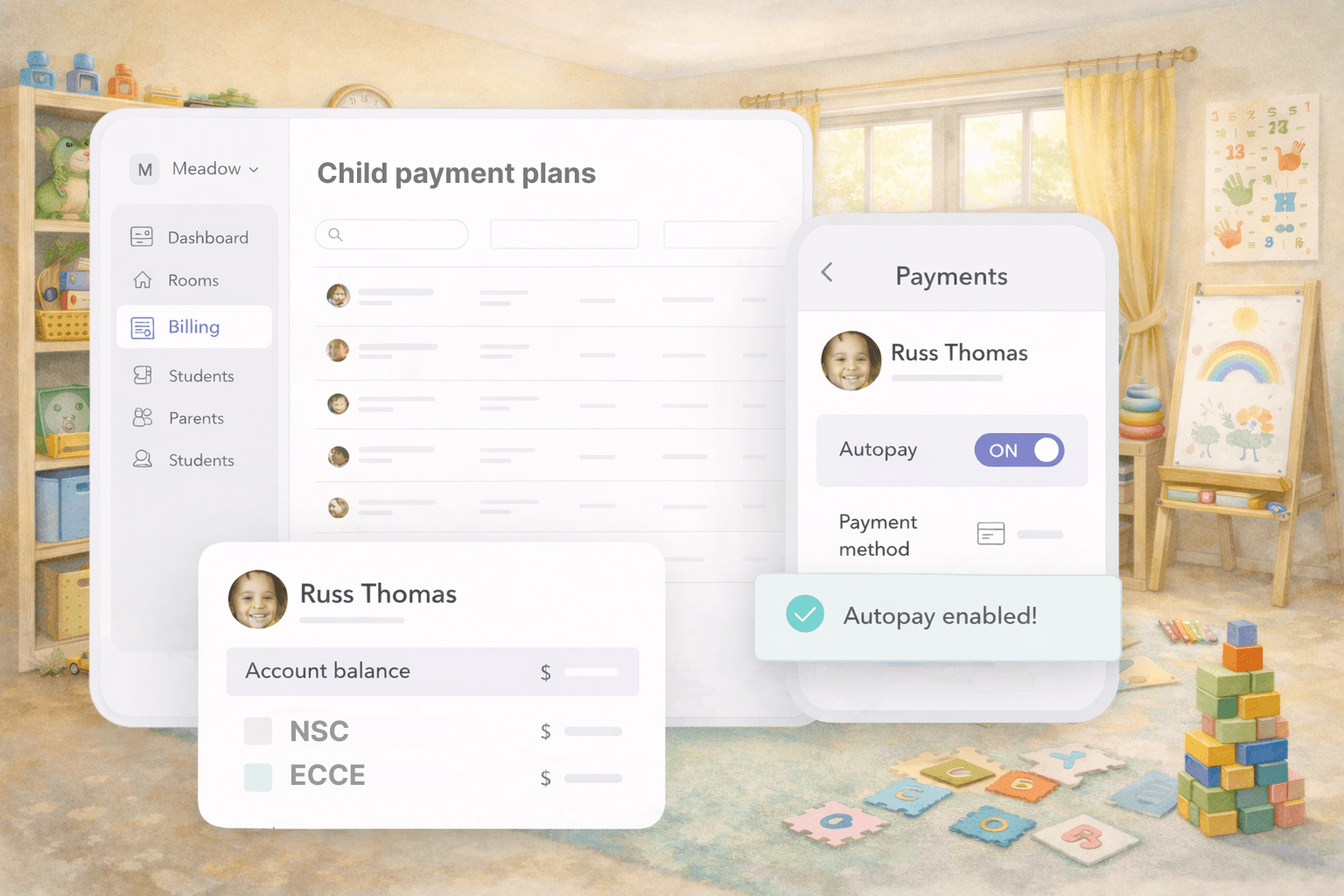
This is exactly the problem we built Meadow to remove. Each child's NCS registration — CHICK number, subsidy type, hourly rate, award dates, and registered hours — lives on their record. You attach it to the child's weekly booking plan, and Meadow shows a live funding allocation: how this week's hours split between ECCE, NCS, and private. Edit the plan and the split updates with it, so what you claim always matches what the child actually attends.
Underneath sits Meadow's event-based attendance: every check-in and check-out is recorded with a time and never overwritten, for children and staff. That's the accurate, dated history an NCS audit asks for — built up as a by-product of the normal day, not a Friday-afternoon scramble. And because award end dates are on the record, a registration that runs past its award is flagged rather than quietly over-claiming.
Fewer surprises at billing time. A confident answer when the auditor asks. And a lot less of your week spent reconciling spreadsheets.
Setting up NCS for the new term? See how Meadow handles funding or book a walkthrough.
This article is general guidance for providers. Always check the official NCS portal and the Department of Children for current rates, hour limits, and rules.