
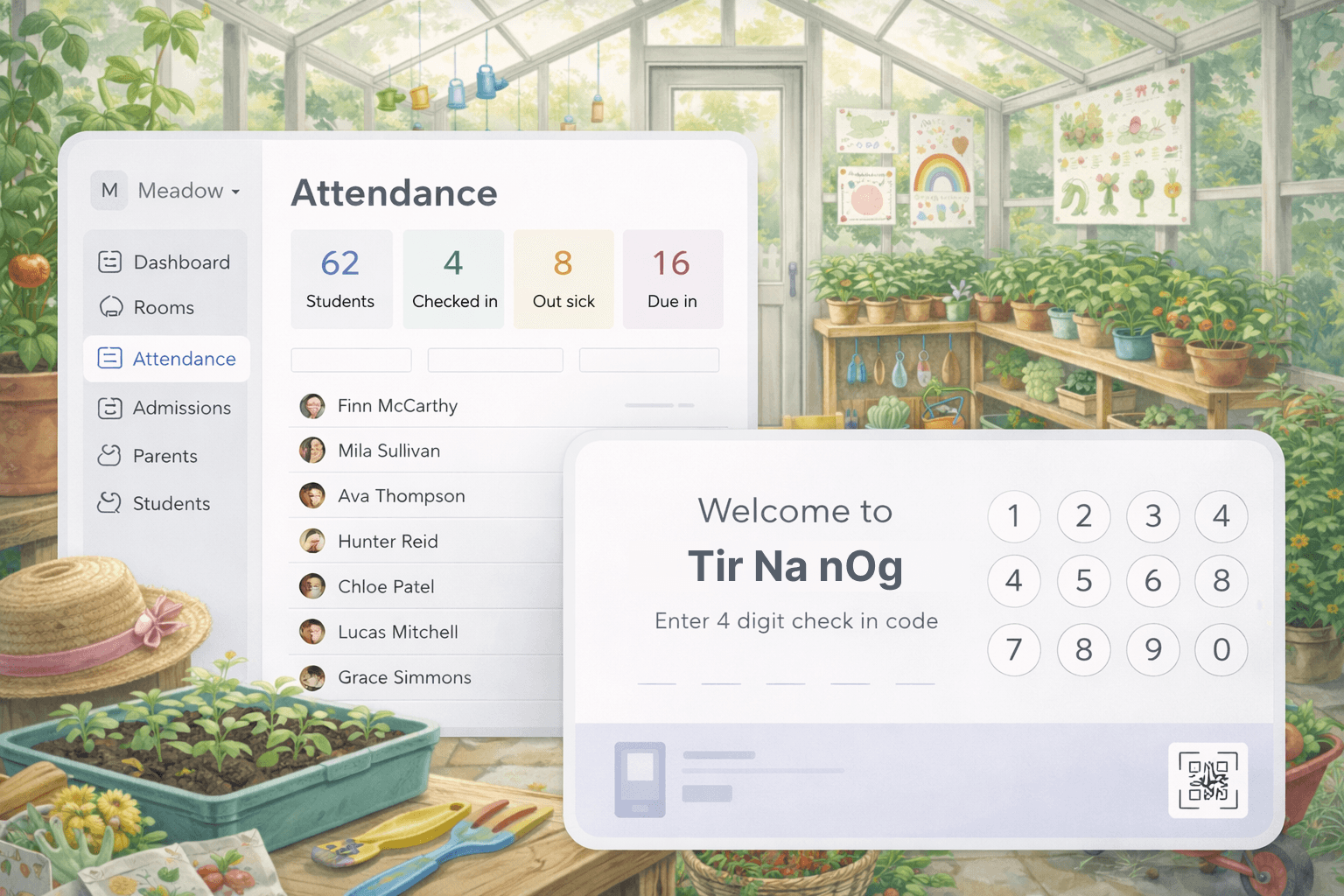
Ask any playschool owner where their week goes and you'll hear the same answer: not where they'd like it to. The care happens in the rooms, but the owner's day fills up with admin — much of it repetitive, much of it avoidable, and some of it carrying real financial risk if it goes wrong.
Here are ten of the worst offenders, and how a well-set-up system hands the time back.
1. Rebuilding the daily register
Counting heads off a paper sheet, then transcribing it, is double work — and a shaky basis for NCS claims. A live attendance view that updates as children are checked in removes the second step and gives you records that stand up.
2. Chasing "who's actually here?"
Walking room to room to count for a fire drill or a ratio check. A live roster per room answers it from your phone.
3. Working out funding splits by hand
For every child: which hours are ECCE, which are NCS, which are private? Done in a spreadsheet it's slow, and a single wrong cell becomes an under-claim you swallow or an over-claim that comes back as a clawback. Tied to the child's booking plan, the split is automatic.
4. Tracking NCS award and renewal dates
Award windows lapse quietly and a child's subsidy stops. A system that keeps award dates on the record means renewals don't depend on memory.
5. Re-keying the same family details
A child's contacts, a sibling's details, an emergency number — typed again and again. Linking siblings and reusing contact records stops the re-typing.
6. Answering "can so-and-so collect today?"
Flipping through a folder at the door. Clear pickup permissions on each child's contacts make it a glance, not a search.
7. Prepping for an inspection or audit
When Tusla calls or an NCS audit lands, piecing the records together from notes is the stuff of nightmares. An immutable attendance history and complete child files mean you're already ready — no late nights.
8. Recording absences twice
Marking a child absent in one place, then adjusting the register in another. When absences and attendance share the same record, marking an absence keeps the day's numbers right on its own.
9. Keeping parents in the loop
Individual texts and photos sent one by one, on your own phone, after hours. A shared activity feed lets families follow their child's day without the second job.
10. Onboarding a new child
A new starter can mean a dozen forms. A guided add-child flow that captures details and contacts in one go turns an afternoon into a few minutes.
The thread running through all ten
Notice what these share: the same information gets handled more than once, or a live answer gets reconstructed by hand. The fix isn't working harder — it's keeping each piece of information in one place and letting the system do the joining up.
That's the idea behind Meadow. Attendance is taken once and feeds the live room view, the history, and the register — the same record that backs your NCS claims and an inspection. Funding lives on each child's plan, so the ECCE/NCS/private split is always current. Contacts, pickups, and emergency details sit on the child's profile. Parents follow their own children through a shared feed. The admin doesn't vanish — but a lot of it stops being your job, and the risky parts stop being risky.
Curious how much of your week you'd get back? See what Meadow does or book a walkthrough.